


 Italiano
 Deutsch
 Français
 Español





In this article, I’ve gathered photos of the small creatures (charming or less appealing) that you might find in a pond. Many of these tiny organisms play a vital role in the ecosystem, helping to keep the water clean, control insect populations, and serve as food for fish and amphibians. Some are predators, others are detritivores, but all contribute to the natural balance of the pond.
Aquatic snails: valuable allies for your pond

On the left, you can see a Lymnaea stagnalis, one of the largest freshwater snails, measuring around 4–5 cm. This species is easily recognised by its long, conical shell and its ability to float by storing air in its lung. It feeds mainly on algae and organic debris, helping to keep the pond water cleaner.
On the right, you can see a small snail from the Physidae family, much smaller at about 0.5–1 cm. These snails are more agile and often hide beneath the leaves of water lilies, especially the older, decaying ones on which they feed.
Aquatic snails are typical inhabitants of ponds and play an important role in the ecosystem:
- They help break down dead leaves and organic debris.
- They keep algae growth under control.
- They serve as food for fish and amphibians, contributing to the food chain.
However, when they become too numerous, they may nibble on the youngest and softest leaves, creating small holes in the plants. In moderate numbers, these snails are excellent allies for maintaining a healthy pond.
Dragonfly larva (left) and adult insect (right)
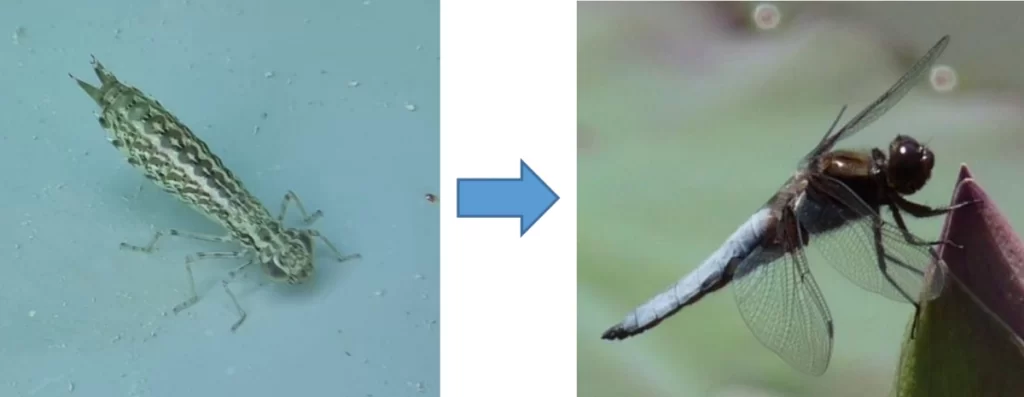
Dragonfly larvae belong to many different species, which is why they may appear more elongated or more compact depending on the variety. They usually measure between 3 and 6 cm and spend their entire juvenile phase underwater, often for several months or even years.
These small predators are exceptional hunters thanks to their remarkable predatory mask – a retractable structure beneath the head that shoots forward to catch prey in an instant. They feed on mosquito larvae, small crustaceans, aquatic invertebrates and even fish fry, playing an important role in maintaining the natural balance of the pond ecosystem.
On the right, you can see the adult insect, which emerges from the water after metamorphosis. Adult dragonflies are agile fliers and continue their predatory lifestyle in the air, feeding on midges, mosquitoes and other small flying insects, making them valuable allies for mosquito control.
Damselfly larva (left) and adult insect (right)

Damselfly larvae look similar to dragonfly larvae, but they are smaller and slimmer, with an average length of about 2 cm. Unlike dragonfly larvae, which have a more robust and compact body, damselfly larvae can be recognised by their elongated shape and by the three leaf-like gills at the tip of the abdomen, which they use to breathe underwater.
Like dragonflies, these larvae are efficient predators, feeding on mosquito larvae, small aquatic invertebrates and crustaceans. Their hunting method is more discreet and less aggressive than that of dragonflies, as they prefer to approach their prey slowly before catching it with their retractable mouthparts.
On the right, you can see the adult insect, which is also smaller and slimmer than a typical dragonfly. Adult damselflies are elegant fliers, often with bright metallic colours, and they are easy to recognise by their behaviour: when resting, they fold their wings along the body, unlike dragonflies, which keep their wings spread out. Even as adults, damselflies play an important role in controlling insect populations by feeding on midges and mosquitoes.
Tadpole (left) and adult frog (right)
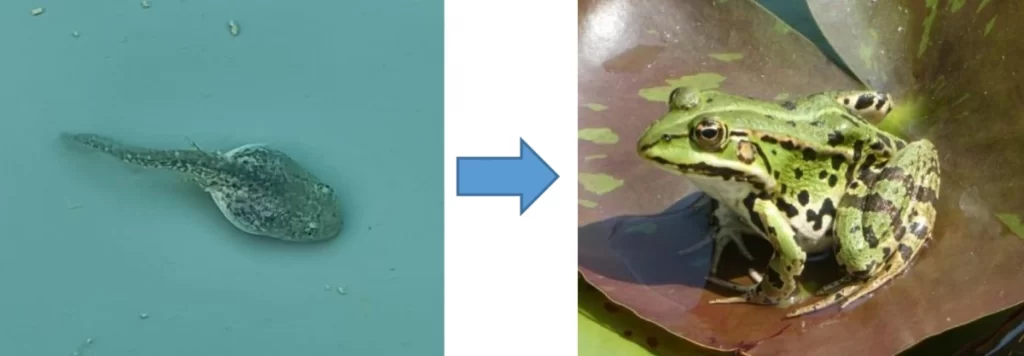
On the left, you can see a tadpole, the larval stage of the frog. In their first days of life, tadpoles are mainly herbivorous, feeding on algae, organic debris and tender leaves in the water. As they grow and develop, their diet changes: they become omnivorous and begin to eat small insects and mosquito larvae, helping to control them naturally.
On the right, you’ll find the adult frog, which has completed its metamorphosis, lost its tail and developed legs. At this stage, its diet becomes entirely carnivorous: it feeds primarily on insects such as mosquitoes, midges, beetles and other small invertebrates. With their sticky tongue and quick strike, frogs are excellent predators and valuable allies in maintaining the ecological balance of the pond.
Throughout their life cycle, tadpoles and frogs play a key role in both aquatic and terrestrial ecosystems. They help reduce insect populations and serve as food for birds, reptiles and other wildlife.
Having frogs in your pond is a sign of a healthy and natural environment!
Toad tadpole (left) and adult toad (right)
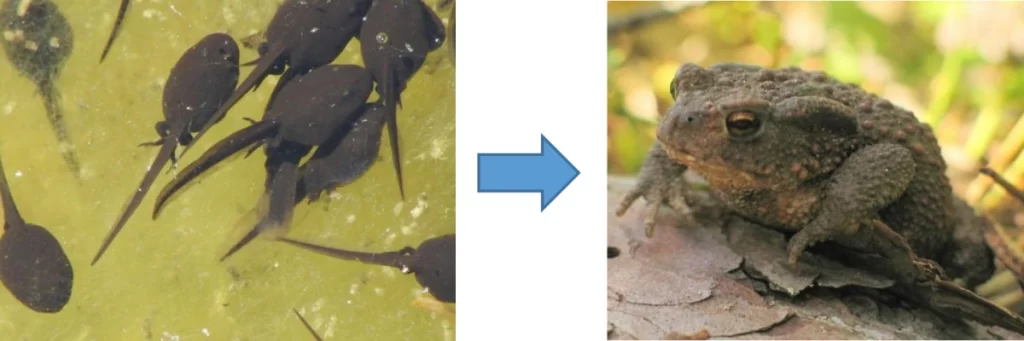
On the left, you can see a toad tadpole, easily recognised by its deep black colour. While frog tadpoles tend to be grey or brownish, toad tadpoles are completely black and smaller in size.
Like frogs, toads lay their eggs in water, but unlike frogs, toad eggs are arranged in long gelatinous strings rather than clusters. Tadpoles spend the first weeks of their life feeding on algae and organic debris, later adding small aquatic invertebrates to their diet.
On the right, you’ll find the adult toad, which has completed its metamorphosis. Unlike frogs, toads are not tied to water: they prefer humid, wooded environments and return to ponds only to reproduce. Their body is stockier, covered in warts, and they often camouflage themselves among leaves and soil.
An interesting aspect of their life cycle is that, out of the thousands of tadpoles that hatch, only a small percentage survive to adulthood. This is because tadpoles are prey for many predators, including fish, birds, and aquatic insects.
The backswimmer: the tiny predator that swims upside down

The backswimmer is a small aquatic insect about 1.5 cm long, easily recognised by its unusual way of swimming: it moves upside down, with its back facing the bottom and its belly just below the water surface.
This insect is an efficient predator, equipped with long, fringed hind legs that it uses as oars to move quickly through the water. It feeds mainly on mosquito larvae, small invertebrates and even fish fry, helping to naturally control insect populations in the pond.
Backswimmers breathe atmospheric air, which they trap under their body thanks to a thin layer of air that clings to their abdomen. Despite their harmless appearance, they can deliver a painful sting if handled, using their sharp mouthparts to inject digestive enzymes into their prey.
These insects are valuable allies for maintaining the balance of the pond, helping to limit mosquito proliferation.
Plea minutissima: the miniature backswimmer

Plea minutissima is a tiny aquatic insect, less than 3 mm long, related to backswimmers but much smaller. It lives in ponds among aquatic vegetation, moving nimbly while holding a bubble of air beneath its body to breathe.
Despite its tiny size, it is an efficient predator, feeding on mosquito larvae and small invertebrates. Like larger backswimmers, it can sting if handled, but it is completely harmless to the pond ecosystem.
Gerrids: the pond’s skating insects

Gerrids, also known as water striders or pond skaters, are aquatic insects capable of walking on the water surface thanks to their long, slender legs covered in microscopic water-repellent hairs that keep them from sinking.
These insects are excellent predators, feeding on mosquito larvae, small insects that fall into the water, and other invertebrates. Their hunting method is unique: they detect vibrations on the water surface caused by the movements of their prey, then dart swiftly towards them to suck out their bodily fluids.
Gerrids are completely harmless to humans and pose no threat to the pond. In fact, they are beneficial because they help keep insect populations under control and contribute to the natural balance of the ecosystem.
If you see them skating across the surface of your pond, it means you have a healthy environment rich in biodiversity!
Larva of a Stratiomyidae fly (left) and adult insect (right)

The Stratiomyidae larva, shown on the left, measures around 4–5 cm and moves through the water with worm-like, undulating motions. Its appearance is not particularly appealing: a flattened, segmented body, usually brown or greyish in colour. However, despite its uninviting look, it plays an important role in the pond ecosystem by helping to break down organic matter.
Fortunately, this type of larva is quite rare to find in a pond.
On the right, you can see the adult insect, which resembles a small fly with an elongated body, often dark or metallic in colour. Unlike the larva, the adult does not live in water and is completely harmless, feeding mainly on nectar and sugary substances.
Diving beetle larva (left) and adult insect (right)

The diving beetle larva, shown on the left, can grow up to 5 cm long and is a voracious predator of aquatic insects, including mosquito larvae, tadpoles and small invertebrates. In this photo, you can see a larva capturing a tadpole, holding it firmly with its powerful hollow mandibles. Through these mandibles it injects digestive enzymes that liquefy the prey, allowing it to suck out the tissues.
On the right is the adult diving beetle, which can reach a length of 3–4 cm. It is an excellent swimmer and moves skilfully through ponds, marshes and wetlands thanks to its hind legs adapted for swimming. It feeds on insects, tadpoles, small fish and other aquatic invertebrates, hunting both underwater and at the surface.
The adult diving beetle can bite humans with its strong mandibles, causing a painful but harmless pinch.
Bloodworms – Chironomid larvae (midge larvae)

Chironomid larvae, commonly known as bloodworms, are small red worms measuring 1–2 cm. They are often seen attached to the rhizomes and growing parts of water lilies, or hidden in the muddy substrate of the pond. Their red colour comes from haemoglobin, which allows them to survive in low-oxygen environments.
These larvae are harmless and play a useful role in the ecosystem: they feed on organic detritus and serve as food for fish and amphibians. After metamorphosis, they turn into adult midges (Chironomids), which look similar to mosquitoes but are completely harmless, as they do not bite and do not feed on blood.
Worms from the Planaria family
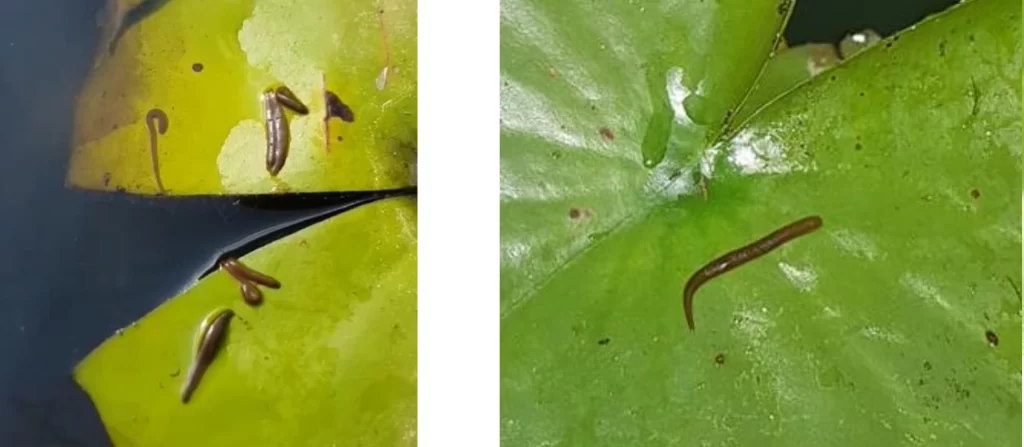
They are 2–4 cm long and move with an undulating motion similar to earthworms. They can be found on the stems and on both the upper and lower surfaces of water lily leaves, where they feed on organic detritus and small invertebrates.
Small crustaceans and zooplankton
Ponds host many tiny aquatic animals that belong to the microfauna and are essential for maintaining ecological balance. These organisms play key roles: some break down organic matter, helping to keep the water clean, while others filter algae and serve as food for fish, amphibians and aquatic insects.
Gammarus (Gammaridae) → 1–2 cm. Small amphipod crustaceans that live among detritus and aquatic vegetation. They are detritivores, meaning they feed on decomposing organic matter, and they are an important food source for fish and amphibians.

Water fleas (Daphnia sp.) → 0.2–5 mm.
Tiny filter-feeding crustaceans that feed on algae and suspended organic particles. They are an essential part of the diet of many fish and amphibian larvae.

Cyclops (Copepods) → 0.5–3 mm.
Planktonic crustaceans with an elongated shape that move in quick, jerky motions. They prey on microorganisms and serve as a food source for small fish and insect larvae.

Ostracods (Ostracoda) → 0.2–2 mm.
Tiny crustaceans with a hard shell, resembling small transparent seeds. They move slowly along the bottom and among vegetation, contributing to the decomposition of organic matter and the filtering of microorganisms.

Even if they are often invisible to the naked eye, these tiny pond inhabitants play an essential role in the food chain and in maintaining water quality, ensuring a healthy and well-balanced ecosystem.
Mosquito larvae

They are about 1 cm long and wriggle like small worms. They can appear in newly set-up ponds or mini ponds. Once dragonfly larvae, backswimmers, gerrids and tadpoles arrive, you won’t see them again – you simply need to wait for their natural predators to come.
If you have a mini pond on a balcony, where it is harder for all these natural predators to appear, or even if you have a pond and want to speed up the elimination of mosquito larvae, I recommend adding Medaka fish.
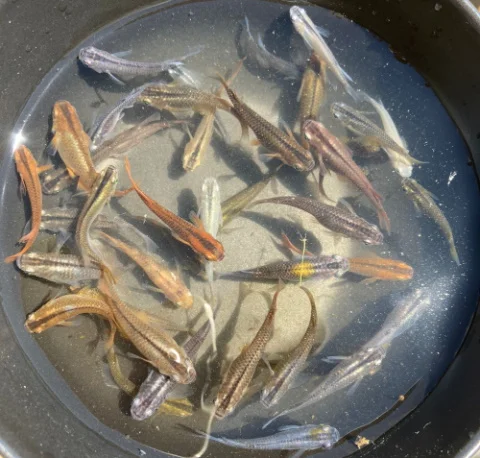
Medaka are small fish about 4 cm long, originating from East Asia, where they live in rice fields. Compared to traditional goldfish, Medaka can live even in small spaces, making them perfect for mini ponds (tubs or containers with aquatic plants).
Because they are small, they do not foul the water as much as goldfish or koi carp, and they also do not damage aquatic plants!
We offer different types of Medaka and can ship them safely to selected areas of Europe.
You can find more detailed information on how obtain a balanced pond to attract wildlife in the pond, in the Guide to Growing Aquatic Plants and in this free Video Course!
This article is also available in Italiano – Deutsch – Français – Español